
City lots on made land
Hydroseeding in Boston, MA
Tight yards, filled marsh and storm drains on every corner call for careful seeding.
- No-charge yard visit and an itemized quote on paper
- Seed blends picked for sun, shade and salt exposure
- Watering and first-mow instructions with every job
Seeding a Lawn Inside the City Line
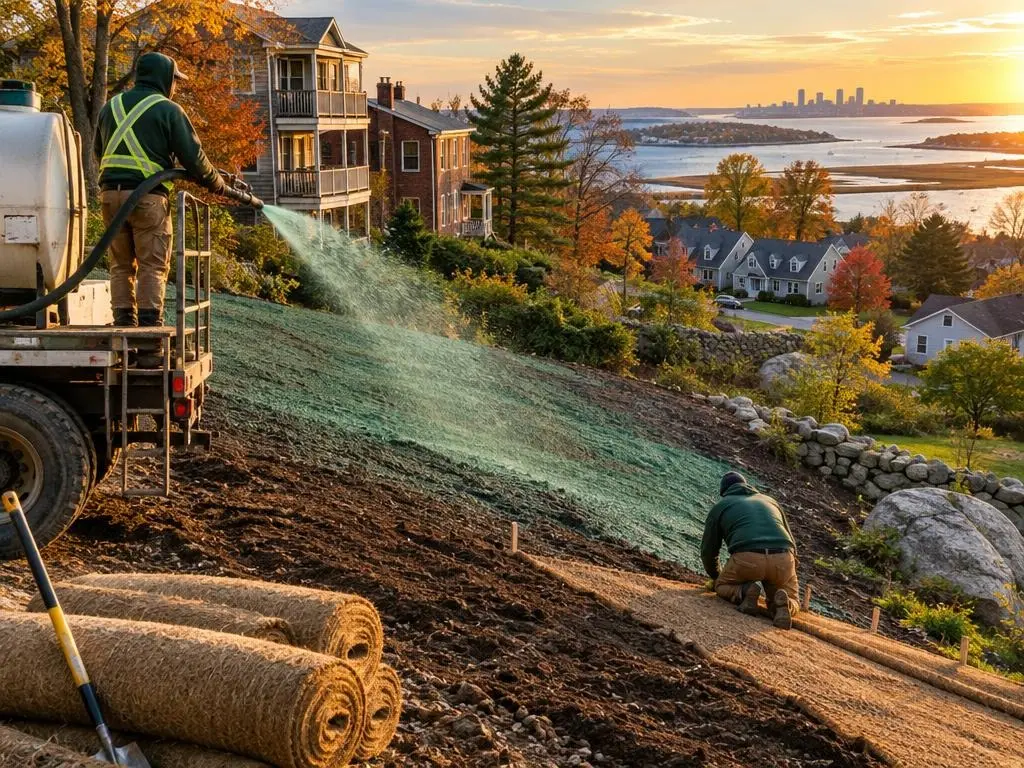
Hydroseeding in Boston usually means small, awkward spaces: a strip between a triple-decker and the sidewalk, a rebuilt backyard after a foundation repair, or a courtyard at a new building in Dorchester or Roslindale. A hydroseed lawn suits these spots because we spray seed, hydromulch and tackifier from a hose, so the truck can stay on the street while the slurry reaches the back of a narrow lot.
Built on made land
More than two-thirds of inner Boston's land did not exist when the city was founded. Marshes, mud flats and gaps between wharves were filled between 1631 and 1890, and after the Great Fire of 1872 building rubble went into the waterfront. On these lots the top layer is often fill, not native soil. Before we seed, we dig a few test holes, rake out brick and cinders, and bring in screened topsoil where the existing layer will not hold moisture.
Water that runs to the drains
Groundwater has dropped in parts of the city, partly because rain goes into sewers instead of soaking in. A bare lot sends silt straight into the nearest catch basin. On city jobs we put inlet protection on the drains, run silt sock or silt fence along the low edge, and keep the mulch layer heavy until the grass knits.
Coast versus inland
The city spans USDA hardiness zone 7a near the water and 6b farther inland. East Boston and South Boston yards see salt air and wind; Hyde Park and West Roxbury, up toward Bellevue Hill at 330 feet, run a little colder. We adjust the seed blend to the exposure rather than using one mix for the whole city.
When to seed
The average freeze window runs from about November 9 to April 5. Late August through September is our first choice, with April and May as the backup. Seed sprayed after mid-October may sit dormant until spring.
What we handle in Boston
- Hydroseeding small residential lots and courtyards
- Topsoil and fine grading over old fill
- Inlet protection and silt sock on construction sites
- Lawn repair after utility or foundation work
Get a free estimate or call (617) 812-0882.
Boston Ground Conditions
- Filled land. More than two-thirds of inner Boston's modern land area did not exist when the city was founded; marshes and flats were filled from 1631 to 1890.
- Hardiness zones. Boston sits in USDA zone 7a near the coast and 6b away from it.
- Freeze window. The average period for freezing temperatures runs from November 9 to April 5.
- Highest ground. Bellevue Hill is the city's high point at 330 feet; much of the rest sits near sea level.
Boston Questions
Can you hydroseed a yard with no driveway access?
Usually, yes. The hose reaches well past the truck, so we can spray a backyard from the street as long as we can run the line through a gate or alley.
My yard is full of brick and cinders. Will seed grow?
Not well in that layer. We rake out debris and add screened topsoil so the roots have real soil to grow in, then spray the seed on top.
Do I need inlet protection for a small lot?
If bare soil can wash toward a street catch basin, it is a good idea. A filter bag or silt sock costs little compared to a clogged drain.
Is a coastal yard in East Boston different from one in West Roxbury?
Yes. Salt air, wind and a slightly milder winter near the harbor change which grasses we lean on. We pick the blend for your exposure.
Free Estimates in Boston, MA
Free estimates for Boston yards and building sites.
Hydroseeding Near Boston
- Hydroseeding in Newton, MA
- Hydroseeding in Wellesley, MA
- Hydroseeding in Needham, MA
- Hydroseeding in Lexington, MA
- Hydroseeding in Concord, MA
- Hydroseeding in Sudbury, MA
- Hydroseeding in Framingham, MA
- Hydroseeding in Natick, MA
- Hydroseeding in Weston, MA
- Hydroseeding in Hopkinton, MA
- Hydroseeding in Andover, MA
- Hydroseeding in Burlington, MA
- Hydroseeding in Hingham, MA
- Hydroseeding in Duxbury, MA
- Hydroseeding in Milton, MA
- Hydroseeding in Canton, MA
- Hydroseeding in Sharon, MA
- Hydroseeding in Franklin, MA
- Hydroseeding in Acton, MA
- Hydroseeding in Dedham, MA
- Hydroseeding in Medfield, MA
- Hydroseeding in Quincy, MA