
Builders and commercial sites
Construction Site Hydroseeding in Boston, MA
Fast cover for raw lots, basins and roadsides, sprayed to the plan and the schedule.
- No-charge yard visit and an itemized quote on paper
- Seed blends picked for sun, shade and salt exposure
- Watering and first-mow instructions with every job
Getting Raw Ground Covered on Schedule
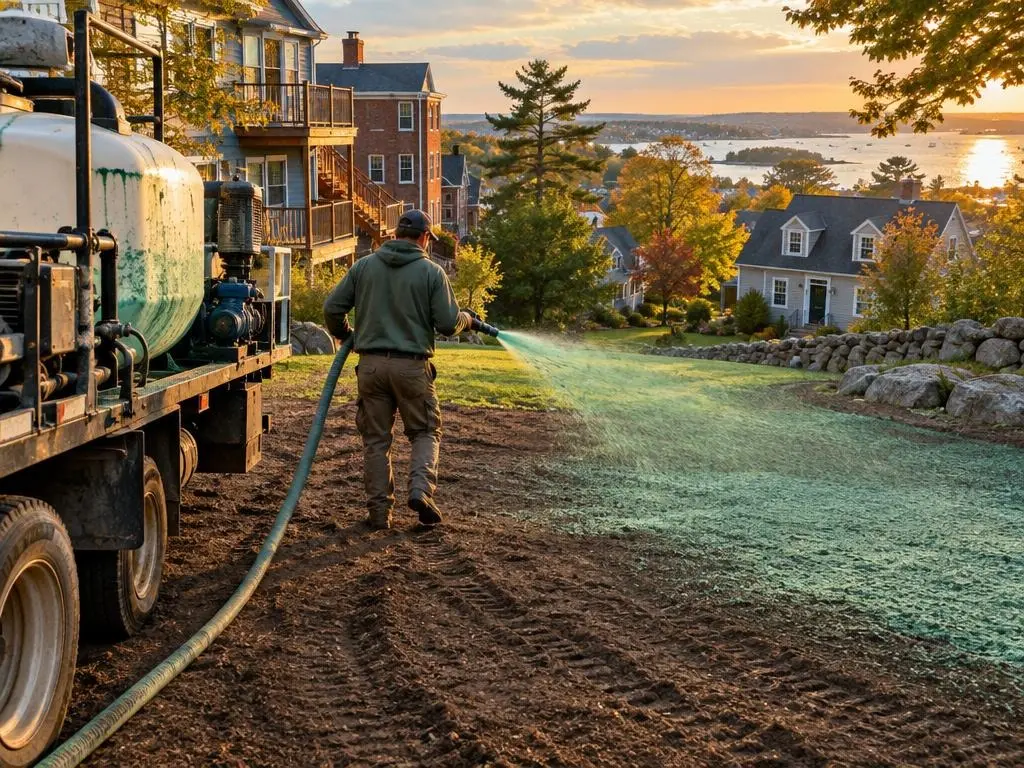
Construction site hydroseeding in Boston covers the jobs where grass is part of finishing the project: new house lots, subdivision roads and shoulders, detention and infiltration basins, commercial lawns, school and municipal grounds, and disturbed areas that have to be stabilized before a site can close out. Builders and site contractors call hydroseeding contractors for the same reasons: a large area, a deadline, and ground that has to stop moving. Our crews spray seed, hydromulch, fertilizer and tackifier from a truck-mounted tank, so one setup can cover a lot of ground quickly.
What builders usually need from us
Most commercial work comes with a plan sheet. It lists the seed mix, the mulch rate, and where temporary and permanent seeding go. We follow it. When there is no plan, we recommend a mix for the end use: a lawn blend for areas that will be mowed, a tougher low-maintenance mix for basins and back slopes, and a fast-cover temporary seeding for stockpiles and areas that will be disturbed again.
Temporary versus permanent seeding
Not every seeded area is meant to be a lawn. Topsoil stockpiles, phase-two pads and rough-graded areas that will sit for a season often need temporary cover so they do not erode. A quick-germinating annual grass and a light mulch rate do that cheaply. Final areas get permanent seeding with the full blend, a heavier mulch and tackifier on slopes.
Ground conditions on Boston-area sites
Construction leaves dense, compacted subsoil at the surface, and around Boston that often means glacial till. The USDA describes Paxton soils as forming in lodgment till, with a dense layer that roots and water struggle to get through. Inside the city, excavated fill with brick and debris is common. Seed sprayed straight onto either one will struggle. We ask the site contractor where topsoil has been placed and how deep, and if a lawn area has only a skim coat, we flag it before we spray.
Weather and the schedule
Boston gets about 43.6 inches of precipitation a year, and nor'easters can bring heavy rain in spring and fall. Fresh seed on a bare slope is most at risk in the first few weeks. We use enough mulch and tackifier for the slope and season, and on steep fills or channel bottoms we recommend switching from standard mulch to bonded fiber matrix or staked blankets. Fall seeding from late August into early October gives the best establishment for cool-season grasses. When a site has to be seeded later, we will talk through dormant seeding and extra mulch so the ground is at least covered over winter.
Coordinating with the rest of the site
Hydroseeding is usually one of the last trades on site, which means it gets squeezed. We work around paving, landscape crews and final grading, and we can split a site into phases so finished areas get seeded while others are still in progress. Silt fence, compost sock and inlet protection are often already in place by the time we arrive; we work inside them and can maintain or remove them when the grass is up. If they are not in place, we can install them as part of the job.
The federal one-acre line
Under EPA rules, a Clean Water Act stormwater permit is required for construction that disturbs 1 acre or more of land. Smaller sites can be covered too, if they belong to a bigger development plan that will disturb an acre or more in total. The federal construction and development rule also calls for disturbed areas to be stabilized immediately when work has stopped and is not expected to restart within 14 days. Hydroseeding is one of the quickest ways to meet that on open ground. Your permit and plan set the specifics; we seed to them.
Comparing hydroseeding companies
When you get several quotes, check that each one lists the same mix, mulch type and rate, tackifier, and fertilizer, and whether watering or a second visit is included. A low per-acre price with half the mulch is not the same product. Our estimates list each of these so they are easy to compare.
Water on site
Hydroseeding uses a lot of water: every tank load is mostly water. On builder sites we ask early where we can fill, whether a hydrant permit is needed, and whether the site has a working spigot. Knowing that up front keeps the spray day on schedule and avoids extra trips.
Seed mixes for basins and back slopes
Detention and infiltration basins swing between standing water after a storm and dry, hot side slopes in August. A plain lawn blend struggles there. For basin floors and banks we suggest mixes with tall fescue and other grasses that tolerate both, and for back slopes that will rarely be mowed, a low-growing fescue blend. When a plan specifies a conservation or wetland-edge mix, we source and spray that instead.
Commercial Work We Take On
From one house lot to a multi-acre development.
New house lots
Final lawn seeding for builders, coordinated with grading and landscaping.
Detention and infiltration basins
Seeding of basin floors and side slopes with a mix suited to wet and dry cycles.
Roadsides and shoulders
Subdivision roads, driveways and parking lot edges seeded and tacked.
Temporary stabilization
Fast cover for stockpiles and rough-graded areas that will sit for a season.
Commercial and municipal lawns
Office parks, schools, parks and field edges.
Phased seeding
Finished sections seeded while the rest of the site is still active.

Large-Area Hydroseeding Prices
| Job | Published range |
|---|---|
| Hydroseeding per acre (LawnStarter) | $2,136 to $4,897 |
| Hydroseeding per acre (Fixr) | $2,000 to $4,000 |
| One acre (HomeAdvisor) | $2,600 to $8,700 |
| One acre (HomeGuide) | $5,000 to $8,500 |
| Two municipal park-seeding bid prices per acre (North Little Rock, Arkansas, 2023) | $2,595 and $3,325 |
National cost guides and one 2023 public bid, not Boston prices. Mix, mulch rate, slopes, phasing and water access all shift the number. Ranges only; the written quote for your yard sets the actual cost.
How We Run a Site
1. Plan review
We read the seeding and erosion control notes and walk the site with your super.
2. Itemized quote
Mix, mulch rate, tack, fertilizer and phases listed per area.
3. Schedule
We book around paving, landscape and final grading.
4. Spray
Temporary and permanent areas seeded to the plan.
5. Check and touch up
We look at germination and fix washouts after storms as agreed.
Why Choose Us for Construction Site Hydroseeding
We follow the plan sheet
Mix and mulch rates match the specification, and we tell you if something on site does not.
We flag thin topsoil
Better to hear it before we spray than after the lawn fails a walk-through.
Comparable quotes
Every line is spelled out, so you can compare our bid with other hydroseeding companies.
Construction Site Hydroseeding Questions
Do you work as a subcontractor for builders?
Yes. Builders, site contractors and property managers make up most of our commercial jobs. We work from your plans and schedule.
Can you seed a site in phases?
Yes. We seed finished areas as they are ready and come back for the rest, which keeps exposed ground to a minimum.
What happens if a storm washes out fresh seed?
Washouts happen on new slopes. We agree in advance how touch-ups are handled, and we use heavier mulch or blankets on the steep spots to cut the risk.
Can you install silt fence and inlet protection too?
Yes. We install and maintain sediment controls and can remove them once the grass is established.

Construction Site Hydroseeding Service Areas
- Hydroseeding in Boston, MA
- Hydroseeding in Newton, MA
- Hydroseeding in Wellesley, MA
- Hydroseeding in Needham, MA
- Hydroseeding in Lexington, MA
- Hydroseeding in Concord, MA
- Hydroseeding in Sudbury, MA
- Hydroseeding in Framingham, MA
- Hydroseeding in Natick, MA
- Hydroseeding in Weston, MA
- Hydroseeding in Hopkinton, MA
- Hydroseeding in Andover, MA
- Hydroseeding in Burlington, MA
- Hydroseeding in Hingham, MA
- Hydroseeding in Duxbury, MA
- Hydroseeding in Milton, MA
- Hydroseeding in Canton, MA
- Hydroseeding in Sharon, MA
- Hydroseeding in Franklin, MA
- Hydroseeding in Acton, MA
- Hydroseeding in Dedham, MA
- Hydroseeding in Medfield, MA
- Hydroseeding in Quincy, MA
Get a Construction Site Hydroseeding Estimate
Send the plans or the address and we will price the seeding.