
Soil prep and yard grading
Topsoil, Grading & Dirt Work in Boston, MA
The shape and soil under a lawn decide how it grows.
- No-charge yard visit and an itemized quote on paper
- Seed blends picked for sun, shade and salt exposure
- Watering and first-mow instructions with every job
Fixing the Ground Before the Grass
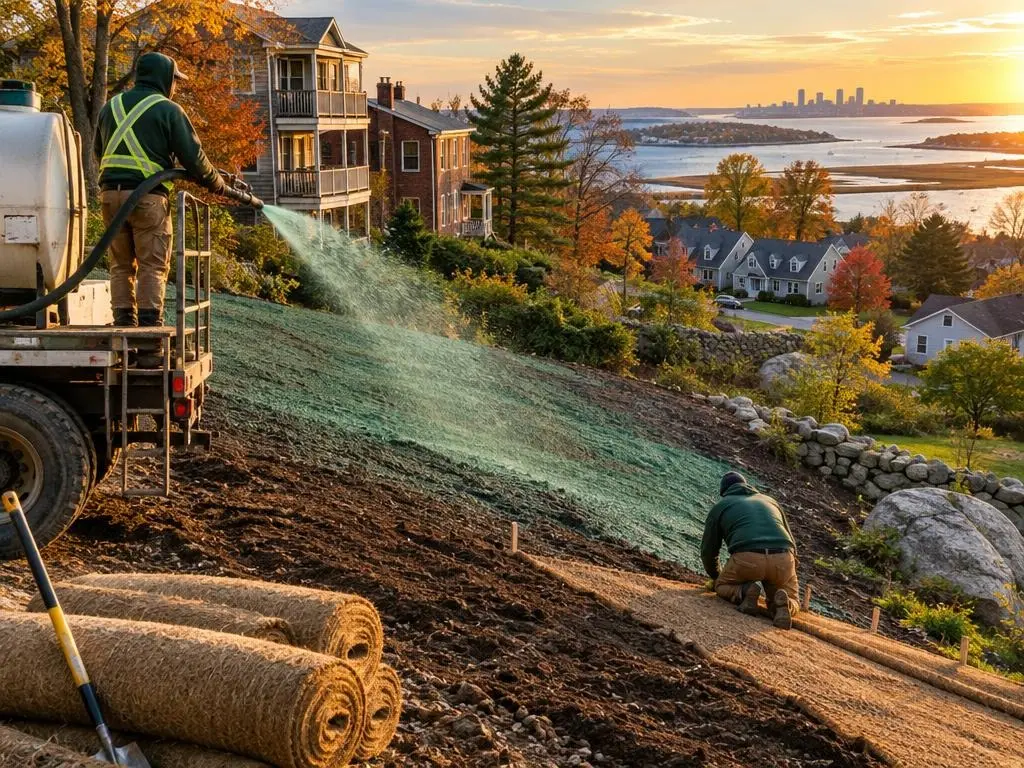
Topsoil, grading and dirt work in Boston is the part of a lawn job you do not see once the grass is up, and the part that decides whether the lawn lasts. We do yard grading to move water away from the house, land grading on larger lots, delivery and spreading of screened topsoil, removal of debris and stone, and fine grading that leaves a smooth seedbed for hydroseed or sod. When regrading alone will not cure a wet yard, the same crew digs the excavation and trenches for drainage, such as a drain line or dry well.
What is under Boston-area lawns
Two very different problems show up around here. In the city, much of the land was built by filling marsh and tidal flats, and later digging turned up more fill. Test holes in a South Boston or Dorchester yard can hit brick, ash, cinders and gravel inches below the surface. That layer drains too fast and holds few nutrients. In the suburbs the issue is the glacial till under Paxton soils. The USDA describes Paxton as a dark brown fine sandy loam over dense till that typically starts between about 20 and 40 inches down. After construction, that dense material often ends up near the surface, packed hard by machines. Roots stop at it and water sits on top of it. Both problems are fixed the same way: get real topsoil on top, at a depth roots can use.
Grading for drainage
Water should run away from the foundation and off the yard, not toward the house or into the low corner where the lawn always stays soggy. We set a grade that falls away from the house, smooth out humps and dips, and direct runoff to a swale, the street, or a drain. Boston gets about 43.6 inches of precipitation a year plus a winter's snow melt, so a yard that pitches toward the house will remind you every spring.
Excavation and trenching
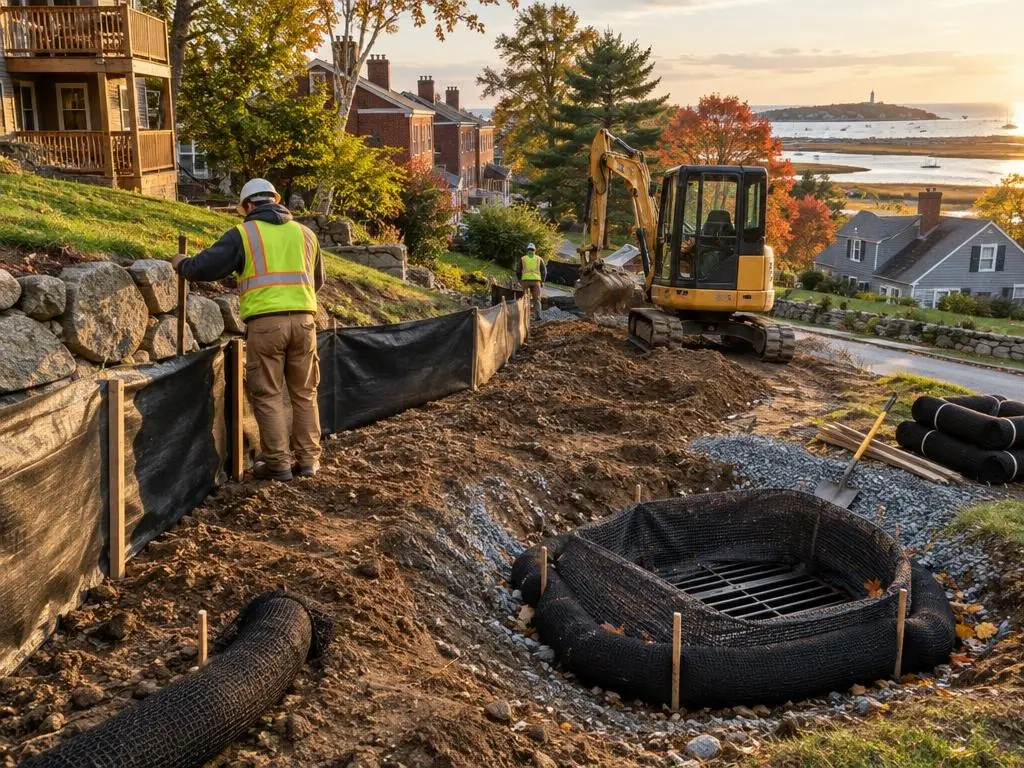
Some yards need more than grading. A low spot with nowhere to drain may need a trench drain or perforated pipe to a dry well or daylight outlet. We dig and set those as part of the yard work, call in utility locates before any digging, and restore the trench line with topsoil and seed. Larger excavation and foundation work stays with a general excavation contractor; we focus on the yard.
Topsoil: how much is enough
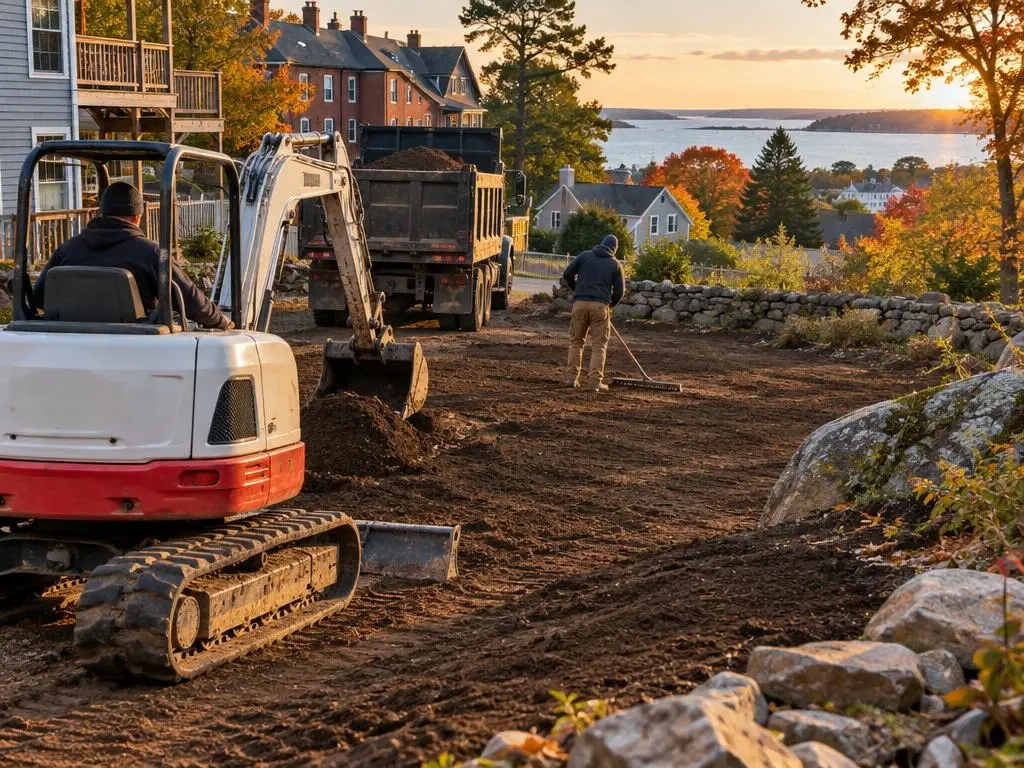
For a lawn we aim for a usable depth of loose topsoil over the subsoil, more on fill or packed till. We use screened topsoil so stones and roots do not end up in the seedbed. Cost depends on how many yards are needed and how far it has to be moved by hand or machine; city lots with no machine access cost more to spread.
Fine grading for seed
The last pass matters. We rake or drag the surface smooth, firm it so footprints are shallow, and leave it loose enough on top for seed to make contact. That surface is what hydroseed sits on, and lumps and dips show up in the finished lawn.
Land grading on larger lots
On acre lots in towns like Sudbury, Concord or Hopkinton, grading is a bigger job: shaping a whole yard so water runs to a swale, cutting down humps left by stumps or old stone walls, or smoothing a field so it can be mowed. We use a skid steer or compact track loader for rough grading and box blading, then finish by hand where the lawn meets beds, walks and the foundation. Glacial stones come up during that work, and we rake out or haul the ones that would get in the way of mowing.
Working near trees
Older Greater Boston lots often have mature oaks and maples, and their roots sit close to the surface. Adding a lot of fill over the roots or cutting them during grading can damage the tree. We keep grade changes light within the drip line of trees you want to keep and talk through the trade-offs with you.
Fill versus topsoil
Fill and topsoil are not the same thing. Fill is cheaper, heavier material used to raise grade or fill holes; topsoil is the loose, organic layer grass grows in. We use fill to build up low areas and then cover it with topsoil, rather than spreading topsoil several feet deep where fill would do. That keeps the cost sensible and gives the lawn the soil it needs.
Drainage on Paxton ground
Because water moves slowly through the dense till under Paxton soils, wet spots on suburban lots often come from water perched on top of that layer after a storm or snowmelt. Regrading the surface handles most of it. Where it does not, a shallow trench drain that catches the water above the dense layer and carries it to a safe outlet is usually the next step.
Dirt Work We Do
From rough grade to a seed-ready surface.
Yard grading
Pitch set away from the house and low spots filled.
Land grading
Larger lots and open areas shaped for drainage and mowing.
Screened topsoil
Delivered and spread to a usable depth over fill or till.
Debris and stone removal
Brick, cinders, roots and glacial stones raked out or hauled.
Drainage trenching
Trench drains and pipe runs dug and set where grading is not enough.
Fine grading
Smooth, firm seedbed ready for hydroseed or sod.
Published Grading and Topsoil Prices
| Item | Published range |
|---|---|
| Lawn leveling, per sq ft (HomeAdvisor) | $1 to $2 |
| Fine grading, per sq ft (Lawn Love) | $0.08 to $1.00 |
| Residential resloping project (Lawn Love) | $770 to $3,000 |
| Topsoil, per cubic yard (HomeAdvisor) | $12 to $55 |
| Truck delivery of topsoil, loads of 15 cubic yards or less (Angi) | $50 to $150 |
| Deliver and spread labor, per hour (Angi) | $60 to $125 |
National cost guides, not Boston prices. Access, the volume of fill or topsoil, and hauling all move the number. Ranges only; the written quote for your yard sets the actual cost.
How Yard Prep Goes
1. Test holes
We check what is under the surface and where water goes.
2. Plan the grade
Where water should run and how much topsoil is needed.
3. Rough grade and drain
Soil moved, debris removed, trenches dug where needed.
4. Topsoil and fine grade
Topsoil spread, raked and firmed for seed.
Why Choose Us for Topsoil, Grading & Dirt Work
We look underneath first
Test holes tell us if we are dealing with fill, till or decent soil.
Drainage solved with the lawn
Grading and trenching are planned with the seeding, not as an afterthought.
Seed-ready surface
The same crew grades and seeds, so the seedbed is right.
Topsoil, Grading & Dirt Work Questions
What topsoil depth does a new Boston lawn need?
It depends on what is there now. On good native soil we may only loosen and top-dress; on city fill or packed till we add more. Test holes tell us before we quote.
Can you fix a yard that slopes toward my house?
Yes. We regrade so water runs away from the foundation, and add a swale or drain if there is nowhere for it to go.
Do you haul away debris and stones?
Yes. Brick, construction debris and the larger glacial stones get raked out and hauled as part of prep.
Do you do excavation and trenching?
For drainage in the yard, yes: trench drains and pipe runs. Foundations and large excavations go to an excavation contractor.
Topsoil, Grading & Dirt Work Service Areas
- Hydroseeding in Boston, MA
- Hydroseeding in Newton, MA
- Hydroseeding in Wellesley, MA
- Hydroseeding in Needham, MA
- Hydroseeding in Lexington, MA
- Hydroseeding in Concord, MA
- Hydroseeding in Sudbury, MA
- Hydroseeding in Framingham, MA
- Hydroseeding in Natick, MA
- Hydroseeding in Weston, MA
- Hydroseeding in Hopkinton, MA
- Hydroseeding in Andover, MA
- Hydroseeding in Burlington, MA
- Hydroseeding in Hingham, MA
- Hydroseeding in Duxbury, MA
- Hydroseeding in Milton, MA
- Hydroseeding in Canton, MA
- Hydroseeding in Sharon, MA
- Hydroseeding in Franklin, MA
- Hydroseeding in Acton, MA
- Hydroseeding in Dedham, MA
- Hydroseeding in Medfield, MA
- Hydroseeding in Quincy, MA
Get a Topsoil, Grading & Dirt Work Estimate
Grading and topsoil: we visit for free and put the estimate in writing.